SaltwaterPhoto.com
  • Home
  • About
  • Photos
  • Video
  • Workshops
  • Resort
  • Articles

I love the intimacy that only a close-up, macro lens can provide. Tight portraits of small subjects reveal a delicate world that is often endearing and helps connect viewers in a way that is both unique and compelling. Over the years, I have experimented heavily with macro photography, revisiting natural effects like bubble bokeh and barrel distortions, creating motion blur, colorizing, and more. As a result, I was labeled "Unhinged," which was one of the greatest left-handed compliments I’ve ever received. Despite the challenges that style of shooting might bring, I still find the most significant test and challenge in capturing something exactly as we see it. 


A curious Blenny gives me the side eye.
Nikon F, 105mm + Nauticam EMWL 160º

I’ve long been fascinated by what it must look like from the critter's point of view. A vast open world to explore, mate, feed, and basically survive. 

Nikon 8-15 @ 8mm, Nauticam zen dome

I also love the way a wide-angle lens can tell a story. A wide-angle lens can provide an inclusive overview of a reef, big animals, wrecks, or scenes that need zero explanation to communicate, drawing the viewer into the experience. Here, we see the texture of the habitat, shadows, and even natural light all playing essential roles in the image.

When we examine both shooting styles, we find a notable middle ground between them. Although many have attempted to bridge the gap between macro and wide-angle photography, the outcomes have often fallen short of capturing the true essence of both styles in a single frame.  

Frogfish and Diver, Nikon F, 105mm + Nauticam EMWL 160º


The “Close Focus Wide Angle” style combines two styles, and when executed correctly, it can offer a well-framed glimpse of our subject within an endless world.

When we approach CFWA from a broad perspective, we often miss the mark because of both our equipment and our mindset. We start by gearing up and going in with a wide-angle focus, then look for smaller subjects to frame up close. While this approach can sometimes work, it often leads to disappointing results. The main subject gets lost in the frame, and the wide-angle perspective suffers as well. The frustration mainly comes from the gear and port setup. Sure, most wide-angle lenses allow focusing right on the port, but maneuvering the port into a tight position is nearly impossible. This affects composition, lighting, and continuity. 


Nudibranch and diver, Nikon F105mm + Nauticam 160º

For years, the go-to setup for APSC shooters was the Tokina 10-17 with a 1.4x Teleconverter. When used behind a small port like the Zen Mini Dome, it was quite effective and enjoyable. However, shot selection remained very important, and getting the port close enough still posed a challenge.  


Lacy Rhinopias and diver
Nikon F105 + EMWL 160º

Recently, the engineers at Nauticam developed an idea to address the gap between Close Focus and Wide Angle, combining the two in a seamless way that opens up new possibilities. For a photographer with thousands of hours of macro shooting, this is more than a breakthrough. It allows precise focus on macro details while maintaining a broad, open background or habitat—creating a unique perspective. Think CF - WA, starting with Close Focus, then adding Wide Angle, and the style begins to stand out

After a few dives with the new lens, I was excited to get back in the water quickly and try to find something else to test the lens on.


Peak of the action!
Nikon F105mm + Nauticam EMWL 160º

How it works - The lens setup is a wet conversion lens, meaning it must be immersed in water to function properly. It is divided into three separate modules: the focus unit at the base, the relay portion which flips the image, and the objective lens itself. I prefer to use the relay lens and 40º viewfinder over a monitor, but removing the relay is also an option. Nauticam also introduced the "Reverse Viewfinder" which flips the image in the same way the relay lens does, except within the viewfinder. For me, this is by far the best option, adding back the organic feel of diving with a standard macro lens.


Larger than life- The CFWA angle of smaller critters creates a unique perspective
Nikon F105+EMWL 160º

I'm shooting with a Nikon Z8 using the Nikon F-mount 105mm lens. The entire lens system measures about 12 inches (30 cm) in length and attaches via bayonet to my macro port. It can be a bit front-heavy.

However, floats can be used to offset weight and provide buoyancy. I’ve also wrapped a thick rubber band around the lens to prevent it from scraping the reef or corals. This is very close work, so careful attention and precautions for both the environment and gear are important.


Creative lighting adds yet another dimension to an already unique composition.
Nikon F105mm + EMWL160º

Lighting and optics:

At first, it was hard to break the old way of thinking wide angle first, but once I shifted my focus to close-up macro, I started to see results.

What surprised me the most is the final push of nearness with the lens, which creates a perspective close to 3D. Like super macro, there is a point where the perspective shifts slightly at the closest working distance. The same effect is seen through the optics of the 160 lens, resulting in a point of view with deep compositions that shows what the subject might see. 

Nikon F105mm + EMWL100º

F105mm + EMWL 160º

Pushing the limits as far as possible, I haven't found any boundaries to what can be achieved in this space. Like in any form of photography, lighting and creative lighting remain constant challenges. The wide lens angle makes it easy to pick up backscatter, but because of the lens's

A world building POV of an Anenome fish aereating its eggs
Nikon 105mm+EMWL-160º

length, there's also a natural level of forgiveness. In fact, using a single strobe is often more effective than dual strobes in mitigating backscatter.


Macro to the glsss gives a natural 1:1 reproduction of the same Nemo eggs as above.
Nikon F105mm+EMWL 160º

Macro in the front, wide-angle in the back; the feel is similar to a +5 macro diopter with wide-angle capabilities. Creating a layered effect is the best way I can describe the thought process behind shooting true CF-WA. Stopping down too much cuts off ambient light, so boosted ISO and slower shutter speeds often come into play to keep a natural background.


Goby with backlit bottle and natural light
Nikon F105mm + EMWL 160º


A candy cane sea cucumber and emperor shrimp
Nikon F105mm + EMWL 100º


Overall, the EMWL system is easy to use and yields superb-quality images while offering unique compositional styles.


 From time to time I'm asked to share my experiences with dive clubs or conventions, even schools. Its such an honor for me and at the same time, I feel that sharing my work with others not only completes part of the circle but is my responsibility. Advocating for the ocean and inspiring others to dive through my work is really the pinnacle of what I do.

Please click on the link below to see the talk, its a bit long so relax, grab a drink and enjoy. At the end there is a short QnA. If you have any questions, please feel free to contact me and ill be more than happy to answer. 

Disclaimer: I am not a scientist and am self taught. If there are mistakes or if I've misidentified any subjects, be kind and email me so I can learn more.

Also please visit the blackwater photo group on Facebook for your daily feed of plankton!


Marine County dive club-August 2021


Enjoy!

A Friday phone call from a friend had me packing my gear and heading to the oil rigs on Saturday morning. I could never pass on the chance to dive the rigs! 

Testing new gear is always fun, especially when it works. Today I had a chance to test the new cutout clamps from ultralight, The new 8K torch from Kraken Sports and the new Sea and Sea YS-D3 Mark 2 strobes.

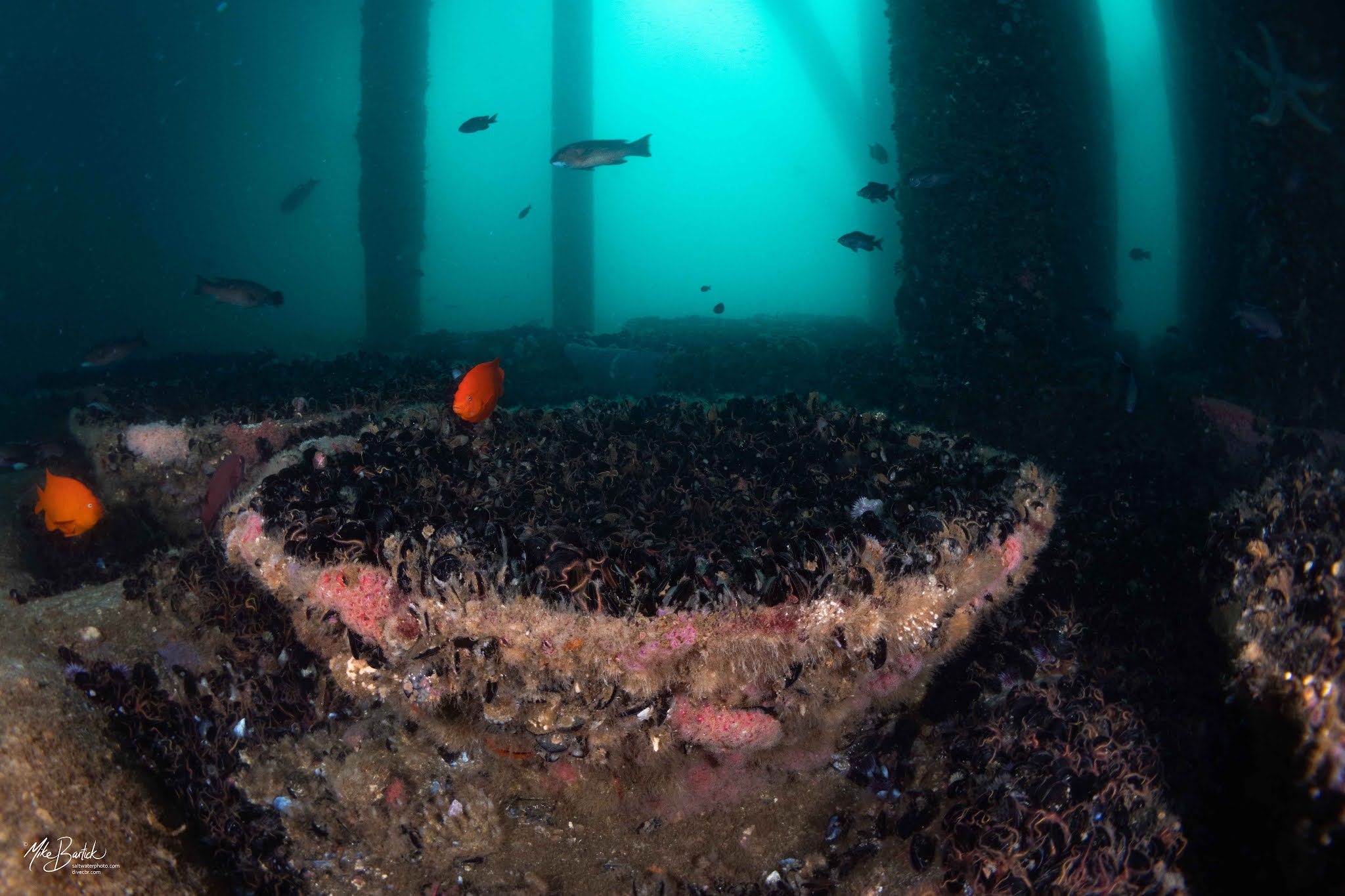
The local oil platforms in Socal. Ellen, Elly and Eureka, regarded as "The Rigs" to local divers, are active, oil producing and processing facilities just a few miles offshore in the San Pedro escarpment. The Pillars, beams and crossmembers that supports these bohemoth megastructures have become an incredible habitat for fish, sea lions and other marine life. From the waterline the rigs are all business. Loud with banging and hissing, pipes banging, catwalks, burn off valves with flames, truly an un-natural and industrial site above water.

Map of the oil platforms in the Southern California area

All of the dives are performed live with the boat backing as close as possible allowing divers to jump in and swim into the underbelly of the beast. The industrial noises are joined by barking sea lions which you can hear once the boat is close enough.

Ellen and Elly are an oasis in a desert of open water

Swells rise and fall around the pilings creating vertical surge as well as horizontal, the constant movement around the pilings can make for a tough dive so be ready for a rodeo.


Rows of bit guides

Man and industry put the rigs here but nature is trying to claim them with growth of all different varieties. The platforms are somewhat antiquated and many are scheduled for removal but what then? The argument being that the benefit of leaving the structures in place far outweighs those of removing them. One look at these structures underwater and its easy to see that it might be better to leave them. 

Colorful cup corals

Underwater the hardscape of the rigs are alive and thriving with life. Often surgy, the current moves through the rigs carrying all kinds of organisms that sticks to the supports under the structure. The growth recruits more animals, creating a thriving secondary habitat for wildlife. Cup corals, muscles, scallops, giant sea stars and anemones, even colorful brittle stars, carpet everything. Like an oasis in the open ocean, these man made structures are vertical reefs pushing up from the deep providing shelter for rockfish and more.


Colorful Anemone's and brittle stars    

Diving here is possible year-round although the conditions aren't always favorable.  My favorite time to dive here is July/August and lasting through October when the water is calm  the visibility is at its very best and there's plenty of sunlight. 


A bright orange Damsel fish, caring for her eggs

I prefer to shoot wide angle on the rigs. Yes, there is plenty of macro to shoot here but the story is best told with wide angle photography. Im using my tried and trusted wide angle conversion lens to cover both bases, just in-case. 
The water can be bluer near the surface but quickly darkens in the shadows and as you get deeper, the water closes in, becoming jade green. Having strong lights helps to navigate through the maze and to bring out the color. 

Plumose anemone-Metridium

At around the 100 foot mark the alabaster white colored plumose anemones can be found growing amidst the cup corals. The white detail is tricky to expose while maintaining a bright background. Im using Sea and Sea YS-D3 strobes with domed diffusers which helps to even out the exposure for this. Using a low powered strobe flash and slow shutter speed helps to retain decent lighting for both.

Salp chain drifting through the structure of Elly

Jellyfish and salp chains drift through the structures regularly so keep an eye on the water column. Fish, such as these chubs and senoritas eat the little crustaceans that live on the salp chains as well as feeding on the salp.

Static lighting using the Kraken 8k WRGBU video light

I used static lighting on dive 3 to shoot this really large sea star that was attached to the piling. The white balance of the Kraken 8K torch is spot on. 

Cabazon at rest, Static lighting using the kraken 8K WRGBU video light

Cabazons can get enormous heads resembling pitbulls and often times found on eggs. They are a subject that I seek out whenever i'm diving the rigs. 

A Cabazon in. defensive posture-Sea and Sea strobes

Another great day to be on the water with friends and on another adventure at sea.

Dive Boat Magician

I highly recommend diving the oil rigs whenever the chance arrises. The unique habitat of hard and soft scape created by nature and man have never married together as well as they do here.

All images shot with Nikon D850 | Sea and Sea Housings | Sea and Sea YS-D3 Mark 2 strobes | domed diffusers with the exception of the Starfish and Cabazon.
60mm with the Kraken wide angle conversion lens 


Special thanks to:
Sea and Sea underwater imaging. See my review here-YS-D3 review
Kraken Sports Kraken Sports
Ultralight Underwater Control Systems ULCS
Erika Helms for inviting me
Magician dive boat for surface support


Is it possible to fall in love with a place?

My first trip to Anilao proved that falling in with a place is totally possible as it happened to me. Sometimes i think if i just did a few more dives the feeling would dissipate, or if i visited more places i might see something else that grabs my attention. 


Reef scene in Anilao


Coming to Anilao for the first time was an adventure that had me scratching my head as the van “stop’n goe’d” through traffic in Bauan. Finally feeling a sense of relief, breaking free and being greeted by the scuba diver in Mabini town.

As the feeling of “what did i get myself into now” began to subside the van made that last left turn and we headed down the peninsula. My first glimpse of the sun glistening on the water nearly took my breathe away,  instantly i heard myself say “wow”.  The flat calm glassy water, Sombrero island in the distance, the blue of Balayan bay. Remarkably, I still get the same feeling, even after traveling through that same stretch of road countless times. So much has changed yet so little is different and each time i arrive in Anilao, i finally feel at home.


Mabini town's triangle greets divers on their way to Anilao and Crystal Blue

Anilao isn’t the true name of this area though. Back in the day, when locals came out to dive, they would park their cars, find a rest place and a dive boat in the Anilao township or Barangay, the road actually ending near the bay. In time, the road extended completely around the peninsula as did the name and now the entire area including the local island is known as “Anilao” to the local and global diving community.


The view from the top of our peninsula. Balayan Bay on the left and the port of Batangas on the right


Dive boats in Anilao are called Banca's. The design is unique to the Philippines 


What makes Anilao so special is the biodiversity and abundance of marine life all packed into such a small area. The peninsula is surrounded by two large deepset bays. On the eastern side the international Bay of Batangas and on the western the Balayan Bay. Along the mouth of those two bays runs the Maricaban straight which converges with the waters from the Verde Island Pass. This sometimes fast moving body of water is a constant source of food for both bays and supplies the local reefs and sandy slopes with its incredible animal life. Nowadays, Anilao is popular, but then there was very little known about the area and getting any information on it was very challenging. 


Diver, exploring just under the boat


Of course i like critters so my focus revolves around our macro dive sites but once you begin to look around, its easy to discover that there are many more layers that exist here and that a lifetime of exploring would be needed to see it all. Beauty like this comes at a price though and Anilao can be a bit bi-polar in its seasonal changes.


The Queen of Macro


7-8 months of bliss can quickly give-way to 4 months of powerful storms. Our weather pattern is very much like the Atlantic Ocean with its hurricane seasons except our storms are called typhoons. There are 2 seasons mainly in all of South East Asia, Dry Typhoon and Wet Typhoon. The reality is that most of the year the water is flat and somewhat calm.


Anilao's, plankton rich waters support a myriad of marine life


Anilaos best kept secrets aren't the critters

Unlike most of the Philippines, the water in Anilao remains cooler, infact the water can be downright cold during certain times of the year. The cold water upwellings and topside winds also compete, turning the water over, transferring the warm water at the surface with cooler waters down deep, refreshing the corals and replenishing the divesites for the next season.


Hairy Frogfish, one of my favorite critters

We know the season is on when hairy frogfish begin to show up on the dive sites. Each season, they tend to settle at some locations before others but eventually several of the sites will have them. Their animated personalities are hard to resist and just watching them is fun to do, especially when they are on the hunt, creeping along and luring.


Diver at Kirbys

I’ve always enjoyed diving the same divesite in California and having the ability to watch it change with the seasons. Already in-tune with that rhythm, it was easy to connect with the similar seasonal pattern here but in a slightly larger sense of the idea. Watching the various divesites populate with soft corals and sponge pushing up from the substrate then the slugs that follow them. Frogfish, sea horses, octopus, blennies, gobies, cuttlefish, mantis shrimp oh my! the macro life begins to explode!


Frogfish at Kirby's

Frogfish are somewhat common in Anilao and if you look closely and move slowly, you will begin to see them. Frogfish use their colorations to mimic sponges, crinoids even urchins. They lie and wait for their victims, hunting in place to conserve energy.

Scarlett colored Scorpionfish, pinnacle area of Kirby's


Nudibranchs of over 1,000 different kinds call Anilao home


The Ghost known as Melibe colemani resembles threadlike algae and soft coral


Miamira alleni is one of Anilao's iconic macro subjects

Some of my favorite areas to dive are really on the coral reef areas such as Beatriz, Apohls, Kirbys, Kuala and our resorts house reef, Arthurs and Arthurs wall. The corals and busy fishlife are visually impactful while the heavy Anthae population adds to the color. Diving on these reefs one can almost feel the heartbeat of the entire area pulsing and moving.


Diver at Beatriz

In love with a place, yes, in love with the people, yes, in love with Anilao, indeed. Anilao is much more than just a dive destination and when your ready to come out and see the best of Anilao, we will be here to welcome you.


Incredible colors of Anilao's reefs are unmatched and truly remarkable


Exploring different areas of the island and peninsula can yield in some very special moments and finds. Cabbage coral is extremely delicate and thrives in some of the protected more areas.

A secret hidden patch of Cabbage Coral


Table corals and barrel sponges adorn almost every reef.

Reef scene, Sombrero island


Anemone fish

The pulse of Anilao is palpable but don't take my word for it, get out there and see for yourself!

Me and my buddies (resort guides) on a day of exploring


CBR from the waterfront


All images were shot with either Nikon D850 or D500, Sea and Sea Strobes

More information regarding the resort and workshops can be found here:


Crystal Blue Resort


Older Posts Home

Copyright © Mike Bartick and SaltwaterPhoto.com. All Rights Reserved.